Thermodynamics laboratory · Completed
Commercial chiller system analysis
A thermodynamic analysis of a Trane CGAM-26 chiller comparing heat-exchanger approach temperature, efficiency, and water flow.
Boston University · ME304 · Team of three · Spring 2025
On this page
- Role
- Team laboratory contributor
- Contribution
- Chiller measurements, thermodynamic calculations, and report preparation with two classmates.
- Evidence
- Calculated COP: 5.437 at 5°F approach vs 3.6109 at 15°F
Objective
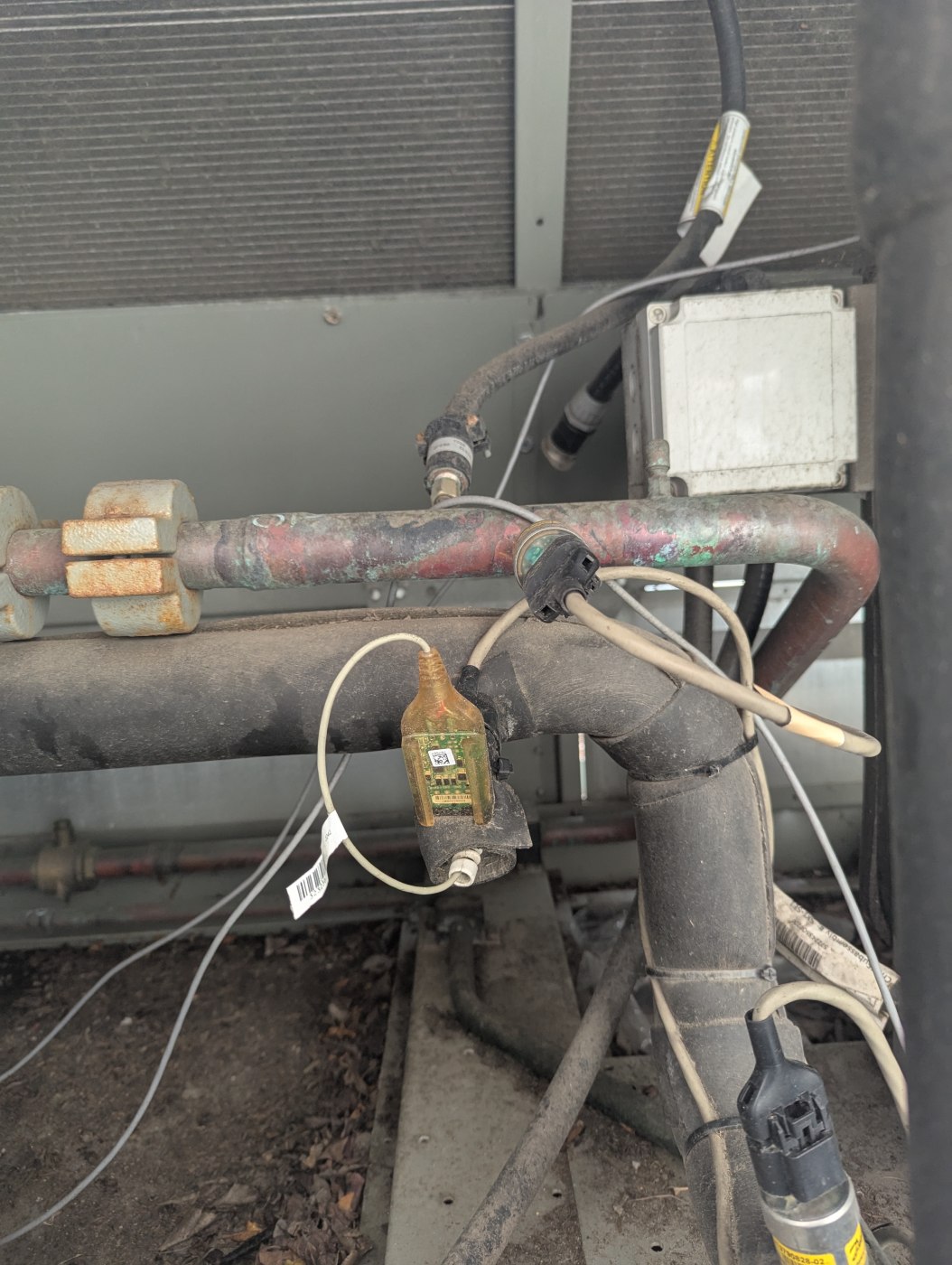
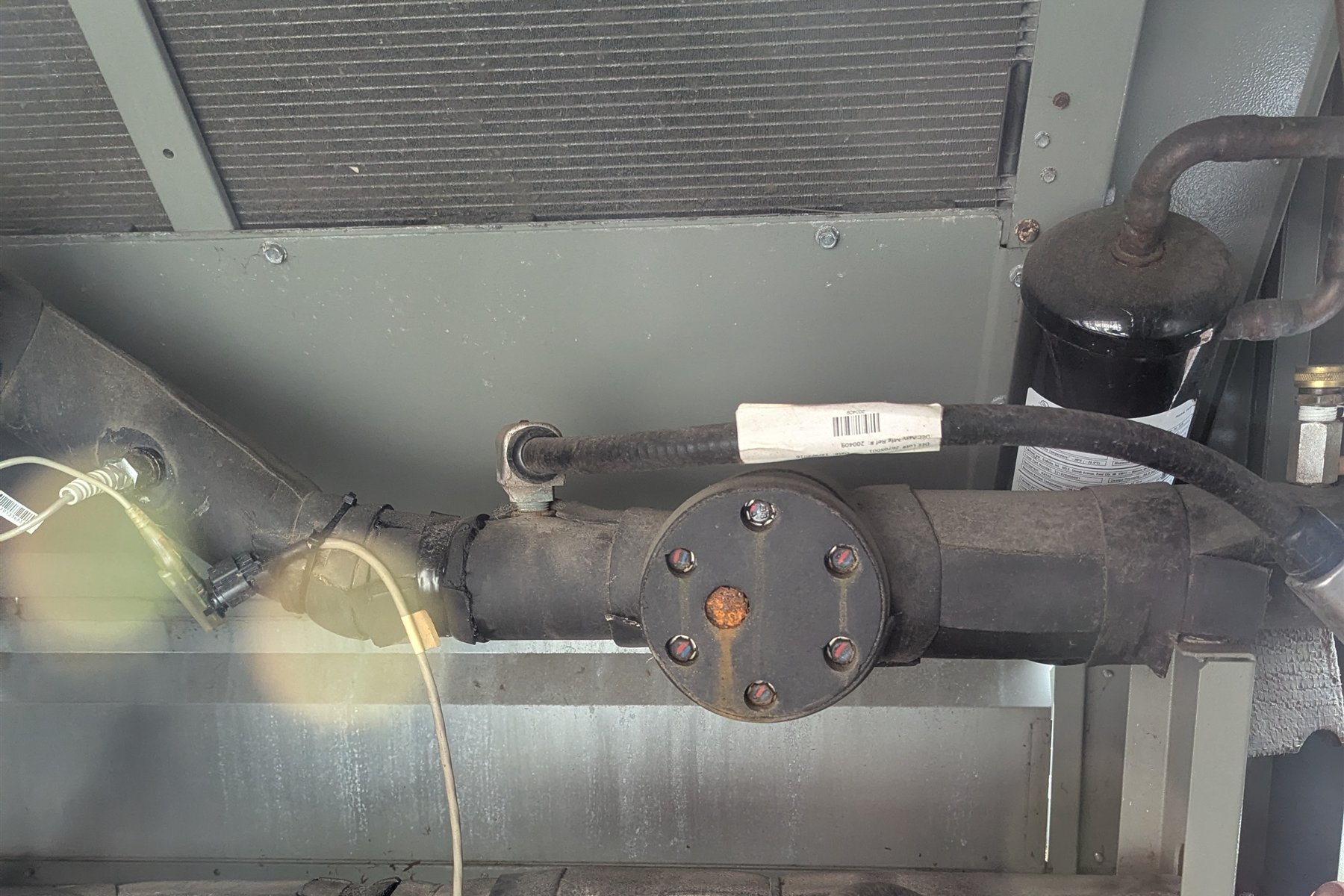
Our three-person team analyzed a Trane CGAM-26 air-cooled chiller. We used measured operating conditions and refrigerant properties to reconstruct the cycle, calculate its coefficient of performance, and estimate the chilled-water flow required at two heat-exchanger approach temperatures.
System model
The unit uses an R-410A vapor-compression cycle. Refrigerant leaves the evaporator as low-pressure vapor, the compressor raises its pressure and temperature, and the condenser rejects heat to outdoor air. The expansion valve then drops the liquid refrigerant to the evaporator pressure so it can absorb heat from the building’s water-glycol loop.
For the two comparison cases, we held the room-side water temperatures at 50°F entering and 44°F leaving, the outdoor air at 85°F, the compressor input at 215 V and 50 A, and the compressor isentropic efficiency at 68%. We used R-410A property tables to determine pressure, enthalpy, entropy, and quality at the four cycle states.
Analysis
We compared otherwise similar cases with minimum heat-exchanger temperature differences of 5°F and 15°F.
| Heat-exchanger approach | Calculated COP | Chilled-water mass flow |
|---|---|---|
| 5°F | 5.437 | 33,075.5 lb/hr |
| 15°F | 3.6109 | 21,966.7 lb/hr |
The smaller approach temperature improved the calculated cycle performance but required roughly 51% more chilled-water flow. The extra flow would affect pump selection, piping, operating power, and cost even though the refrigeration cycle itself appears more efficient.
The 5°F case gave an evaporating temperature of 39°F and a condensing temperature of 90°F. The 15°F case widened those limits to 29°F and 100°F. That wider temperature lift increased the calculated compressor work per unit of cooling, which reduced COP from 5.437 to 3.6109.
Design tradeoff
The higher COP does not settle the system-level choice by itself. Holding the same six-degree water temperature drop while increasing chilled-water flow from 21,966.7 to 33,075.5 lb/hr changes the required pump capacity and the friction losses in the loop. The report did not calculate pump power, so the comparison supports a refrigeration-cycle conclusion rather than a claim that the 5°F case uses less total building energy.
Assumptions
The model held the outdoor temperature and room cooling load constant. It treated water as incompressible with constant specific heat and used tabulated refrigerant properties at the calculated states. A more complete system comparison would include pump power, part-load operation, heat losses, and measurement uncertainty.
We also treated the paired low-side and high-side pressures as equal where the property-table values were close and neglected heat transfer through the insulated piping. Those choices made the state calculations tractable, but they leave pressure drop and ambient heat gain outside the model.
My contribution
I completed the laboratory and report as one member of a three-person team. The report records the measurements, calculations, and conclusions collectively, so this page does not assign individual ownership to a particular measurement or section.